
Spring update from our executive director
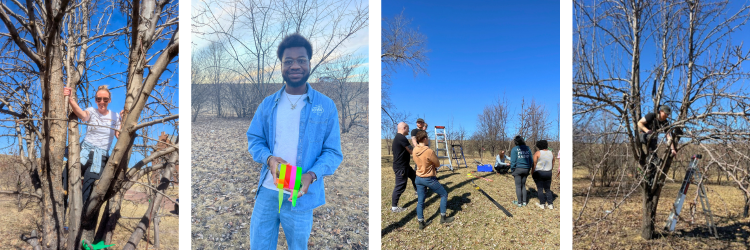
During that beautiful stretch of warm days we had in early March, a few of us gathered to prune fruit trees in west Rock Island.
Tapestry Farms recently purchased our first piece of land—a half-acre orchard with about 40 trees, thanks to a generous donation from two of our long-time supporters. We are taking the first steps to creating a learning orchard and food source for our community, and we are pretty excited about that.
Some of the crew had zero experience with pruning (me!). Some brought extensive knowledge of fruit trees and what needs to be cut away in order for them to flourish (here’s looking at you, Emily Swihart, Adam Heninger, and Sayed Esmail Emran).
It was therapeutic to chop away dead and unneeded branches—trees need air and sunshine to grow fruit. A couple of us climbed up into the trees. The newbies among us got to try out some new tools. And spending a gorgeous day outside with friends? Yes, please.
Even as the wind, snow, and cold came this past week, we take heart in knowing that the work we did earlier this month will bear fruit once this weather passes.
The orchard is now one of my favorite reminders that deep roots are vital for getting through challenges. Refugees, and the people who support them, are facing difficult and uncertain times:
Food stamps have been cancelled for more than half of our families, and those same families will lose Medicaid coverage this coming fall. We are thankful for the people from St. Paul Lutheran Church who are standing in the gap with a twice-monthly distribution of nutrient-dense food, and our kind donors who help fill the shelves of our free pantry. We are working with families on plans to maintain health care coverage, especially for the children and adults who will suffer or die without access to medical care.
We continue to file green card applications as quickly and carefully as possible. For the past several months, we increased our focus on green card applications because federal law now says that regaining food stamps and Medicaid depends on refugee families obtaining their green cards. However, the federal administration then decided to halt processing of green card applications for refugees indefinitely. On top of that, earlier this year, an increased level of urgency emerged. Filing those green card applications is a matter of keeping refugee families from being detained, as the administration issued a memo saying it can detain refugees who have been in the country for more than one year and have not filed for their green cards. Of note is that refugees cannot file their applications until they have been in the country for a year. Agents followed through on that new policy during the enforcement surge in Minneapolis, detaining a number of refugees and sending them to Texas. And while a federal judge issued an injunction against the practice and ordered those who were detained released, his ruling only pertains to his jurisdiction, Minnesota.
It’s a lot to take in, especially given the 45-year history of our country welcoming more than 3 million refugees through the program that has roots in Iowa. We stand firm as we wait for all of this to pass.
Back to the orchard. It’s at 715 4th Avenue, Rock Island, if you’d like to stop by and take a look sometime. You will see we still have work to do, but that is OK. It’s a beautiful piece of land, and we can hardly wait to see the leaves come out this spring. Most importantly, as we gather to prune, we know we have the support of people like you who care about our work. And for that, we are abundantly grateful.
Sincerely,
Ann McGlynn, executive director